On this page
- Glasses and plastic go in the upper rack only, open ends down. 12
- Check by hand that no item blocks a spray arm. 25
- Mix cutlery up and down in the basket so nothing nests. 3
- Quick Wash suits less than half a load of lightly soiled dishes and uses Air Dry. 4
- Normal is the everyday cycle on the 2025 manual's cycle chart. 1
How should I load a Frigidaire dishwasher?#
Scrape off large food, then load glasses and plastic in the upper rack with open ends down. Put plates, bowls and pans in the lower rack with dirty sides facing the center. Keep every item clear of the spray arms and check by turning them by hand. 12
Frigidaire says the racks and baskets differ by model, so the manual for your model has the exact layout. The rules below hold across the manual and the Owner Center articles we used. 12
Before you load#
Scrape away large pieces of food, bones and pits. The manual says the continuously filtered wash fluid removes what remains, so a full pre-wash is not needed. Burned-on food should be loosened first, and liquid should be emptied from glasses and cups. 1
There is one exception. Mustard, mayonnaise, vinegar, lemon juice and tomato-based foods can stain stainless steel and plastic if they sit for a long time. If you will not run the dishwasher soon, rinse those off first or use the rinse-only cycle. 15
Load racks so tall items do not stop the detergent dispenser from opening. If the dishwasher drains into a food disposer, run the disposer until it is empty before you start. 15
What goes in the upper rack?#
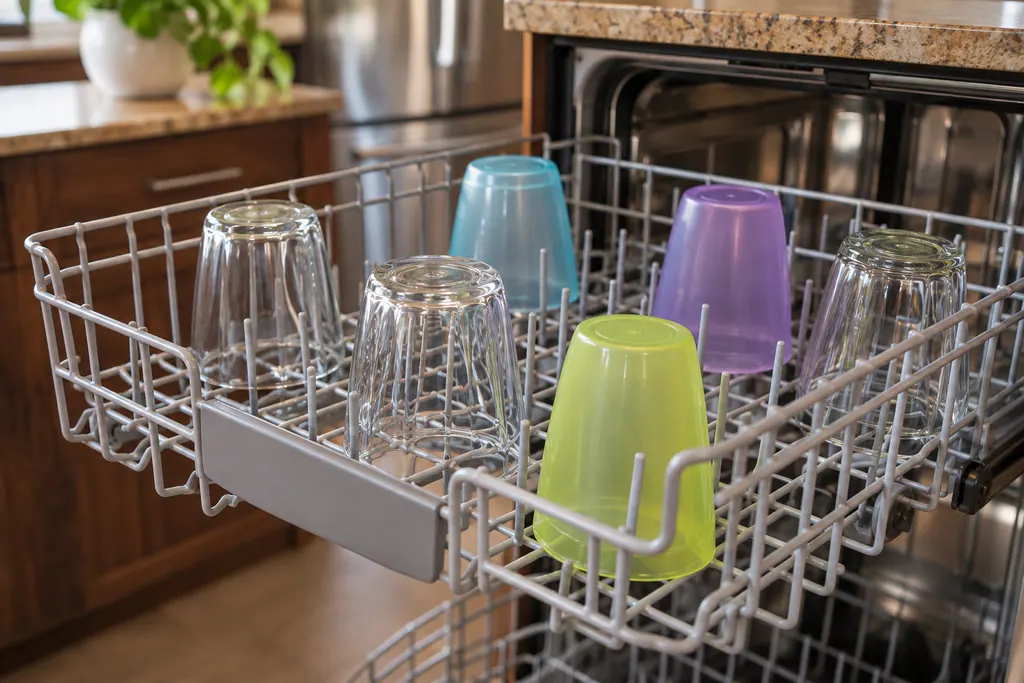
Cups, glasses, stemware and small plates go in the upper rack, along with small bowls, open ends facing down. Glasses and plastic go here only. Do not let delicate items touch, and keep every item clear of the middle spray arm. 12
The manual explains the reason in plain terms: glasses in the bottom rack can be damaged, and plastic there can melt. The upper rack is also where long-handled knives and utensils can lie. 1
Two checks make the upper rack work:
- Nothing through the floor. Be sure nothing protrudes through the bottom of the rack, because it could block the middle spray arm. 2
- Nothing touching. Delicate items that bump during the cycle can be damaged. 12
Some models have a fold-down cup shelf or a stemware holder, which creates a second level for short items. Stagger the items on the upper level so water can reach their inside surfaces. 1
What goes in the lower rack?#
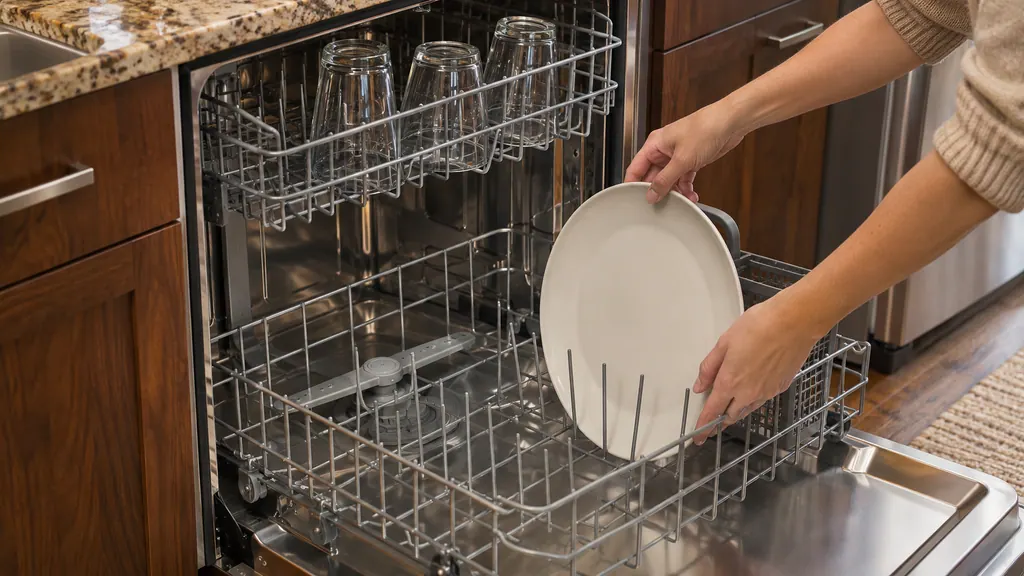
Plates, saucers, bowls and cookware go in the lower rack. Place large items along the edge so they do not block the spray arm, set bowls and pans with the soiled side down or toward the center, and tilt them slightly so water drains. 12
Pan handles are a common culprit. The manual says to be sure handles do not poke through the bottom of the rack and stop the spray arm from turning. Tall items can do the same. 12
The hand test#
After loading, turn each spray arm with your hand. If it moves freely all the way round, start the cycle. If it catches, rearrange. Frigidaire repeats this check in every loading section, which tells you how often it is the cause of poor results. 15
How do I load the silverware basket?#
Load the basket while it sits in the bottom rack, or take it out and fill it on the counter. Mix items so some point up and some point down, so nothing nests, because water spray cannot reach nested pieces. Sharp items go with the points down. 13
If your basket has lids, the covered sections are for small items such as baby bottle caps and jar lids. Close the lid to hold them in place. 3
Do not mix silver and stainless in one basket, because it can damage the silver finish. Also make sure nothing pokes through the bottom of the basket or the rack where it could block the spray arm. 35
When should I use Quick Wash and when should I use Normal?#
Use Quick Wash or Fast Wash for less than half a load of lightly soiled dishes or silverware. Use Normal for everyday loads. The manual calls Normal Wash the recommended cycle for typical use, suitable for a wide range of load sizes and soil. 14
Frigidaire's article adds one warning. Quick Wash and Fast Wash use Air Dry rather than a heated dry, so some dishes may not dry completely. If you need dry dishes, that is a reason to choose a longer cycle instead. 4
The 2025 manual labels its short cycle "1 Hr Wash", recommended for lightly soiled loads only. Its cycle chart gives about 1 hour for 1 Hr Wash and 2 to 2.75 hours for Normal Wash (not counting drying time). 1 The two sources differ on drying: the article says Air Dry on the short cycle, while the manual lists Heat Dry as an option for 1 Hr Wash. Check the chart for your model. 14
| Cycle on the 2025 manual | Meant for | About how long | Options listed |
|---|---|---|---|
| Heavy Wash | Pots, pans, casseroles, light to heavily soiled | 2.5 to 3.75 hours | Sanitize, Max Dry, Heat Dry 1 |
| Normal Wash | Lightly to heavily soiled loads | 2 to 2.75 hours | Sanitize, High Temp, Max Dry, Heat Dry 1 |
| 1 Hr Wash | Lightly soiled loads only | 1 hour | Heat Dry 1 |
| Energy Saver | Lower energy use | 2 to 2.5 hours | Heat Dry 1 |
Cycle names and times differ by model, so use the chart in your own manual. 1
Does the cycle I pick change the cleaning?#
On the 2025 manual's dishwasher, a sensor checks how much soil is on the dishes in the Heavy and Normal cycles and adjusts the water fills, so cycle time and water use vary. The manual also says cycle times change with the options selected and the incoming water temperature. 1
If the incoming water is not hot enough, the manual says the cycle is lengthened to heat it. For good results the water entering the dishwasher should be at least 120°F (49°C), and you can run the hot tap nearest the dishwasher for a few minutes before starting. 1
What if dishes stay dirty or damp despite careful loading?#
Check the spray arms, the water temperature and the detergent before blaming the machine. Blocked arms, water cooler than 120°F, too little detergent for your water, or a short cycle on a heavy load are the usual reasons Frigidaire gives. 14
Work through these in order:
- Arms. Turn each one with your hand. 1
- Hot water. Run the nearest hot tap until it is hot before you start. 1
- Cycle. A heavy load on Quick Wash will come out less clean and less dry. Choose Normal. 14
- Detergent and rinse aid. The manual covers dose by water hardness and says rinse aid improves drying. 1
- Door. Press START, then shut the door right away. If the door is opened mid-cycle, the cycle must be resumed within 10 minutes. 1
If all of that checks out, see dishwasher not cleaning and dishwasher not drying.
For the service itself, see our dishwasher service page.
Sources#
- Dishwasher use & care, A23587501B (November 2025)Frigidaire / Electrolux · November 2025 · pp. 6-9 (cycles, options), p. 8 (door opened mid-cycle), pp. 9-11 (loading), p. 12 (detergent), p. 13 (rinse aid, water temperature)
- What is the best way to load my dishwasher to optimize my cleaning performance? (KB 1852992)Frigidaire / Owner Center knowledge base · Owner Center article, cached 10.11.2026 (no edition date printed) · Article text
- What is the best way to load the silverware basket? (KB 1852993)Frigidaire / Owner Center knowledge base · Owner Center article, cached 10.11.2026 (no edition date printed) · Article text
- Dishwashers - When is it best to use Quick Wash or Fast Wash Cycles? (KB 1847437)Frigidaire / Owner Center knowledge base · Owner Center article, cached 10.11.2026 (no edition date printed) · Article text
- Dishwasher - Loading Guide (KB 1834625)Frigidaire / Owner Center knowledge base · Owner Center article, cached 10.11.2026 (no edition date printed) · Article text